
CyberCodeAcademy

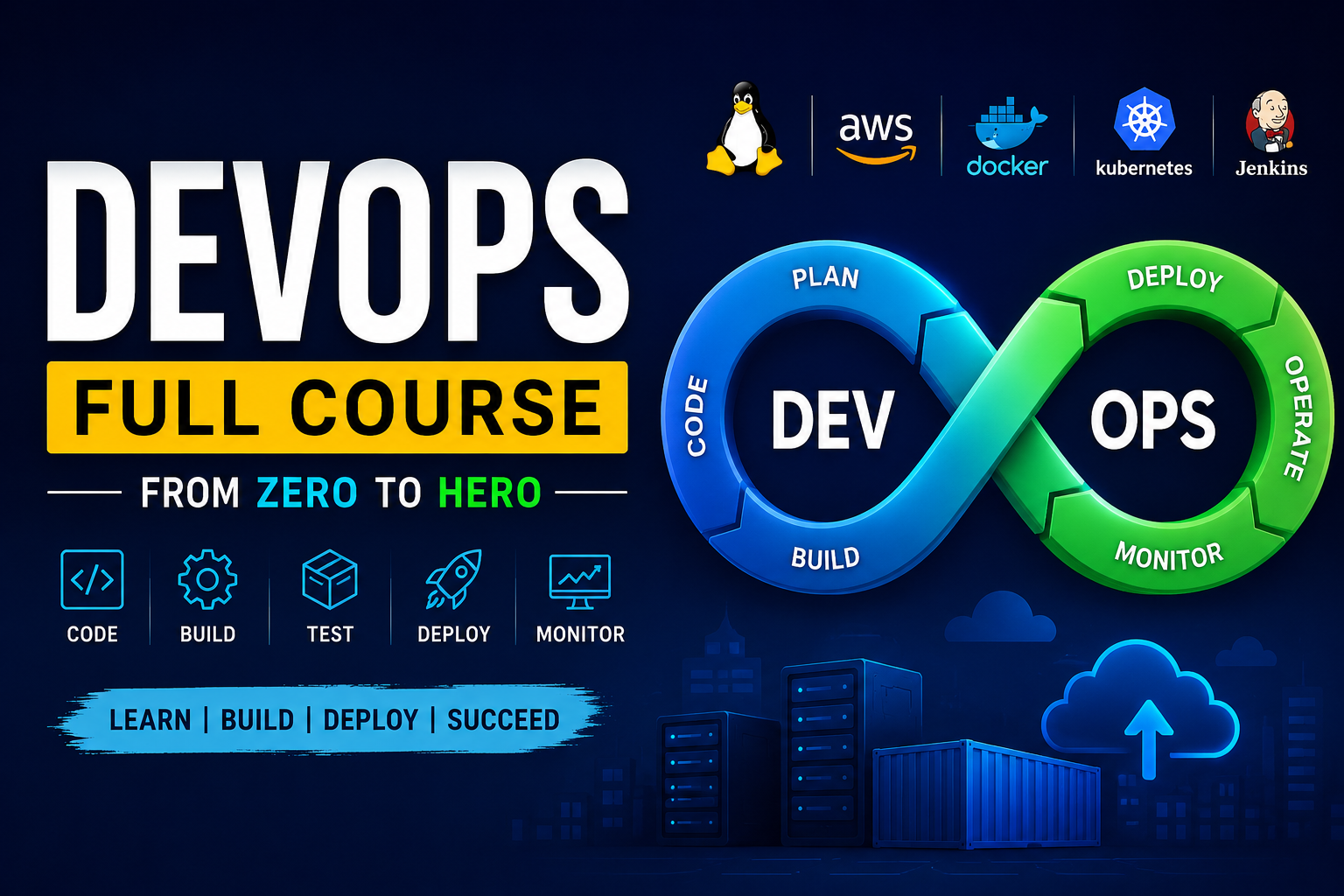
DevOps Zero to Hero Program
Uncategorized
Wishlist Share

About Course

This comprehensive DevOps course will help you master modern DevOps tools and practices used by top technology companies. You will learn how to automate software development, testing, deployment, monitoring, and infrastructure management.

The course starts with Linux fundamentals and gradually moves toward advanced DevOps concepts like containerization, orchestration, Infrastructure as Code, CI/CD pipelines, cloud deployment, monitoring, and automation.

You will gain practical experience by working on real-world projects using tools such as Git, GitHub, Docker, Jenkins, Kubernetes, Ansible, Terraform, and AWS.

By the end of this course, students will be able to:

  • Understand DevOps lifecycle and workflow
  • Manage Linux servers confidently
  • Use Git and GitHub for version control
  • Build CI/CD pipelines using Jenkins
  • Create and manage Docker containers
  • Deploy applications using Kubernetes
  • Automate infrastructure with Terraform and Ansible
  • Work with AWS cloud services
  • Monitor applications and servers
  • Prepare for DevOps Engineer job roles
Show More

What Will You Learn?

  • Understand the fundamentals of DevOps and modern software delivery
  • Learn Git and GitHub for version control and collaboration
  • Build CI/CD pipelines using Jenkins and GitHub Actions
  • Learn Docker containerization and image management
  • Understand Kubernetes basics and container orchestration
  • Work with Infrastructure as Code using Terraform
  • Learn cloud deployment on AWS/Azure/GCP
  • Monitor applications using Prometheus and Grafana
  • Automate server configuration using Ansible
  • Implement DevSecOps and security best practices

Course Content

Introduction to DevOps
Learn the fundamentals of DevOps, including collaboration between development and operations teams, automation concepts, Agile practices, and the complete DevOps lifecycle used in modern software companies.

Linux Fundamentals
Understand Linux operating systems, command-line usage, file management, user permissions, networking commands, and shell scripting required for DevOps engineering.

Git & GitHub
Master version control using Git and GitHub. Learn repository management, branching, merging, pull requests, and collaboration workflows used in real-world projects.

Continuous Integration (CI)
Continuous Integration is a DevOps practice where developers frequently merge their code changes into a shared repository. Each integration triggers automated builds and testing processes to detect errors early. CI helps reduce integration problems that usually happen when multiple developers work on the same project separately. The process encourages small and frequent code commits instead of large updates. Automated testing is one of the most important parts of CI because it ensures that the application remains stable after every change. Tools like Jenkins, GitHub Actions, GitLab CI/CD, and CircleCI are commonly used for implementing CI pipelines. CI improves software quality by identifying bugs quickly and making debugging easier. It also increases collaboration among team members because everyone works on the latest version of the code. Faster feedback is another major advantage because developers know immediately whether their code works properly. Overall, CI creates a reliable and efficient software development environment.

Continuous Delivery (CD)
Continuous Delivery is the practice of automatically preparing code changes for release to production. It extends Continuous Integration by ensuring that applications can be deployed at any time. In CD, all code changes go through automated testing and deployment stages before reaching production environments. This process reduces manual effort and lowers the risk of deployment failures. Continuous Delivery allows organizations to release updates faster and more frequently. Teams can confidently deploy changes because every update has already passed multiple quality checks. It also improves customer satisfaction since new features and bug fixes are delivered quickly. Infrastructure automation is often combined with CD to ensure consistency across environments. Popular tools for Continuous Delivery include Jenkins, Argo CD, GitLab CI/CD, and Spinnaker. CD helps businesses achieve agility and maintain high software reliability.

Infrastructure as Code (IaC)
Infrastructure as Code is a DevOps concept where infrastructure is managed using code instead of manual processes. Servers, networks, databases, and cloud resources are defined in configuration files. IaC allows teams to automate infrastructure provisioning and management. This approach reduces human errors because infrastructure setups become repeatable and standardized. Terraform, AWS CloudFormation, and Ansible are widely used IaC tools. IaC supports version control, meaning infrastructure changes can be tracked just like application code. Teams can recreate environments quickly in case of failures or scaling requirements. It also improves collaboration because infrastructure definitions are shared among team members. Automation through IaC saves time and increases deployment consistency across development, testing, and production environments. Overall, IaC is essential for scalable and efficient cloud operations.

Containerization
Containerization is a technology used to package applications along with their dependencies into isolated units called containers. Containers ensure that applications run consistently across different environments. Docker is the most popular containerization platform used in DevOps. Unlike traditional virtual machines, containers are lightweight and share the host operating system kernel. This makes them faster to start and more resource-efficient. Containers simplify application deployment because developers no longer face compatibility issues between systems. They also improve scalability because multiple containers can run on the same infrastructure. Containerization supports microservices architecture by allowing independent deployment of application components. Security and portability are additional advantages of containers. Overall, containerization increases flexibility, efficiency, and consistency in modern software development.

Kubernetes
Kubernetes is an open-source container orchestration platform used to manage containerized applications. It automates deployment, scaling, and monitoring of containers. Kubernetes helps organizations manage large numbers of containers efficiently. It provides features like automatic scaling, load balancing, self-healing, and rolling updates. Kubernetes works well with Docker and other container runtimes. Clusters in Kubernetes consist of master nodes and worker nodes that coordinate application workloads. It also supports high availability by automatically restarting failed containers. Developers use YAML configuration files to define deployments and services. Kubernetes simplifies management of microservices applications in cloud environments. It has become one of the most important technologies in modern DevOps practices.

Version Control Systems (VCS)
Version Control Systems help developers manage changes to source code over time. Git is the most widely used version control system in DevOps. VCS allows multiple developers to work on the same project simultaneously without conflicts. Every change made to the codebase is tracked and stored in repositories. Developers can create branches to work on features independently and merge them later. Version control improves collaboration and code quality because all modifications are documented. It also supports rollback functionality, allowing teams to restore previous versions if errors occur. Platforms like GitHub, GitLab, and Bitbucket provide cloud-based repository hosting. VCS is essential for CI/CD pipelines because automated systems rely on repositories to detect code changes. Overall, version control is a foundational component of modern software development.

Cloud Computing in DevOps
Cloud computing provides on-demand access to computing resources such as servers, storage, and databases over the internet. DevOps teams use cloud platforms to build, deploy, and scale applications efficiently. Major cloud providers include AWS, Microsoft Azure, and Google Cloud Platform. Cloud environments support automation, scalability, and flexibility. Teams can quickly provision resources without purchasing physical hardware. Cloud services integrate well with CI/CD pipelines and Infrastructure as Code tools. They also enable global application deployment with minimal effort. Pay-as-you-go pricing models help organizations reduce infrastructure costs. Cloud platforms provide managed services for databases, monitoring, security, and networking. Cloud computing has become a central part of DevOps because it accelerates software delivery and innovation.

Configuration Management
Configuration Management is the process of maintaining consistency in system configurations across multiple servers and environments. It ensures that infrastructure settings remain standardized and controlled. Tools like Ansible, Puppet, Chef, and SaltStack automate configuration tasks. Configuration Management reduces manual work and prevents configuration drift between systems. It also improves scalability because large infrastructures can be managed centrally. Teams use scripts and templates to define desired system states. Automation ensures that systems are configured correctly every time. Configuration Management supports faster deployments and easier maintenance. It is especially important in large cloud environments where hundreds of servers may exist. Overall, it enhances operational efficiency and system reliability.

DevSecOps
DevSecOps is the practice of integrating security into every stage of the DevOps lifecycle. Instead of treating security as a separate process, DevSecOps makes it part of development and operations workflows. Security checks are automated within CI/CD pipelines. This allows vulnerabilities to be detected early during software development. Tools like SonarQube, Snyk, and OWASP ZAP help identify security risks automatically. DevSecOps encourages collaboration between developers, operations teams, and security professionals. It improves compliance with security standards and reduces the chances of cyberattacks. Automated scanning ensures that dependencies and infrastructure configurations remain secure. Continuous monitoring also helps detect suspicious activities in production environments. DevSecOps creates a balance between fast software delivery and strong security practices.

Microservices Architecture
Microservices Architecture is a software design approach where applications are divided into small independent services. Each service focuses on a specific business function and communicates with other services using APIs. This architecture improves scalability because services can be scaled independently. Development teams can also work on different services simultaneously without affecting the entire application. Microservices support faster deployments and easier maintenance. Containerization and Kubernetes are commonly used with microservices. Fault isolation is another benefit because failure in one service does not necessarily crash the entire system. However, managing communication and monitoring between services can be challenging. Tools like API gateways and service meshes help manage microservices environments. Overall, microservices provide flexibility and agility for modern applications.

Automation in DevOps
Automation is one of the core principles of DevOps. It involves using tools and scripts to reduce manual tasks in software development and infrastructure management. Automation can be applied to testing, deployment, monitoring, security, and configuration management. By automating repetitive tasks, teams sav

Student Ratings & Reviews

No Review Yet
No Review Yet